
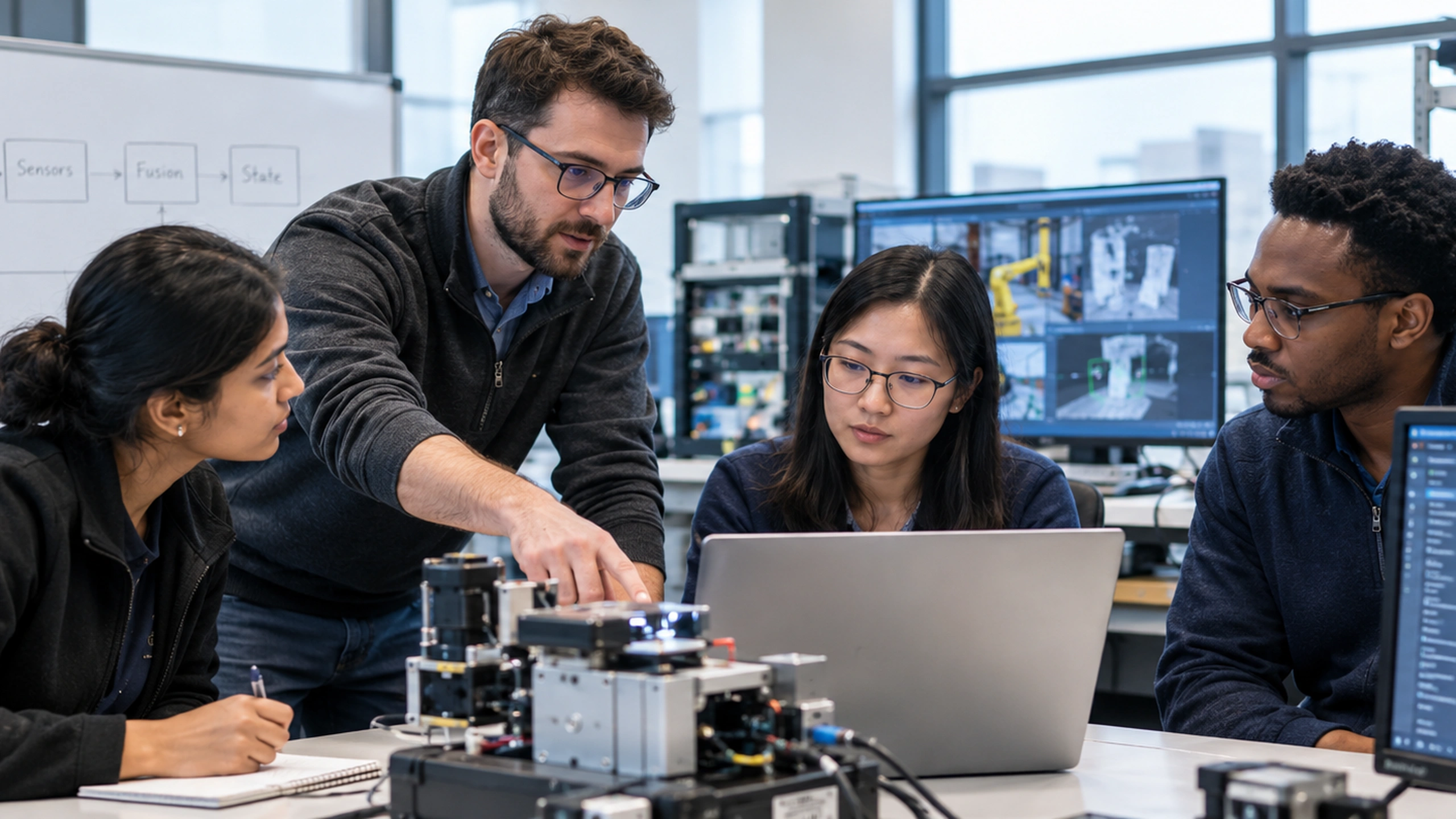
Research Team | Aperture Identification and Sensing Labs
Aperture Identification and Sensing Labs focuses on the research challenges involved in establishing dependable identity, location, condition, and operational context from imperfect observations. Addressing these challenges requires careful problem definition, sound measurement practices, rigorous evaluation, and clear reporting of uncertainty and limitations.
Contact UsResearch responsibilities
Identification and localization
Research in this area examines how observations from technologies such as RFID, Bluetooth Low Energy, ultra-wideband, and vision can be associated with the correct item or asset and used to estimate location. Important questions include identity ambiguity, coordinate frames, indoor-to-outdoor handoffs, and recovery when observations conflict.
Sensor reliability and data quality
This area addresses the conditions that make sensor data unreliable, including drift, incorrect units, clock faults, stale values, missing observations, and sensor substitution. Evaluation should distinguish a real change in the physical environment from a measurement or data-pipeline fault.
Multimodal sensing and state estimation
This work considers how measurements from different modalities can be aligned and combined while preserving uncertainty. Relevant evaluation dimensions include fusion error, confidence calibration, latency, and behavior when one or more sources become unavailable.
World-state grounding and industrial context
Research in world-state grounding connects identity and location estimates with timestamps, task context, and subsequent observations. The objective is to make the system’s current view of the physical environment queryable and to identify when the evidence is too old or uncertain to support a reliable conclusion.
Experimental design and evaluation
Research evaluation requires explicit hypotheses, documented test conditions, appropriate baselines, independent ground truth, and metrics matched to the physical problem. Reports should separate proposed experiments, simulations, physical trials, supervised pilots, and deployments, and should document failures as well as successful cases.
Research standards
The team’s public-facing research descriptions should explain the physical problem before describing a method or result. Claims should be supported by evidence and reviewed by the appropriate technical lead. Performance figures should include their measurement context, baseline, sample scope, units, and uncertainty where applicable.
A method demonstrated in a controlled testbed should not be described as proven in an industrial deployment unless that deployment and its outcomes have been verified. Equipment, facilities, partner organizations, and publications should be named only when ownership, participation, or publication details have been confirmed.
Work with the research program
Industrial technical teams, researchers, and technology partners with identification, sensing, localization, or state-estimation challenges can learn more about collaboration through the program’s collaboration pages. A useful inquiry describes the physical process, the observations available, the uncertainty or failure that matters, and the intended evaluation outcome.