
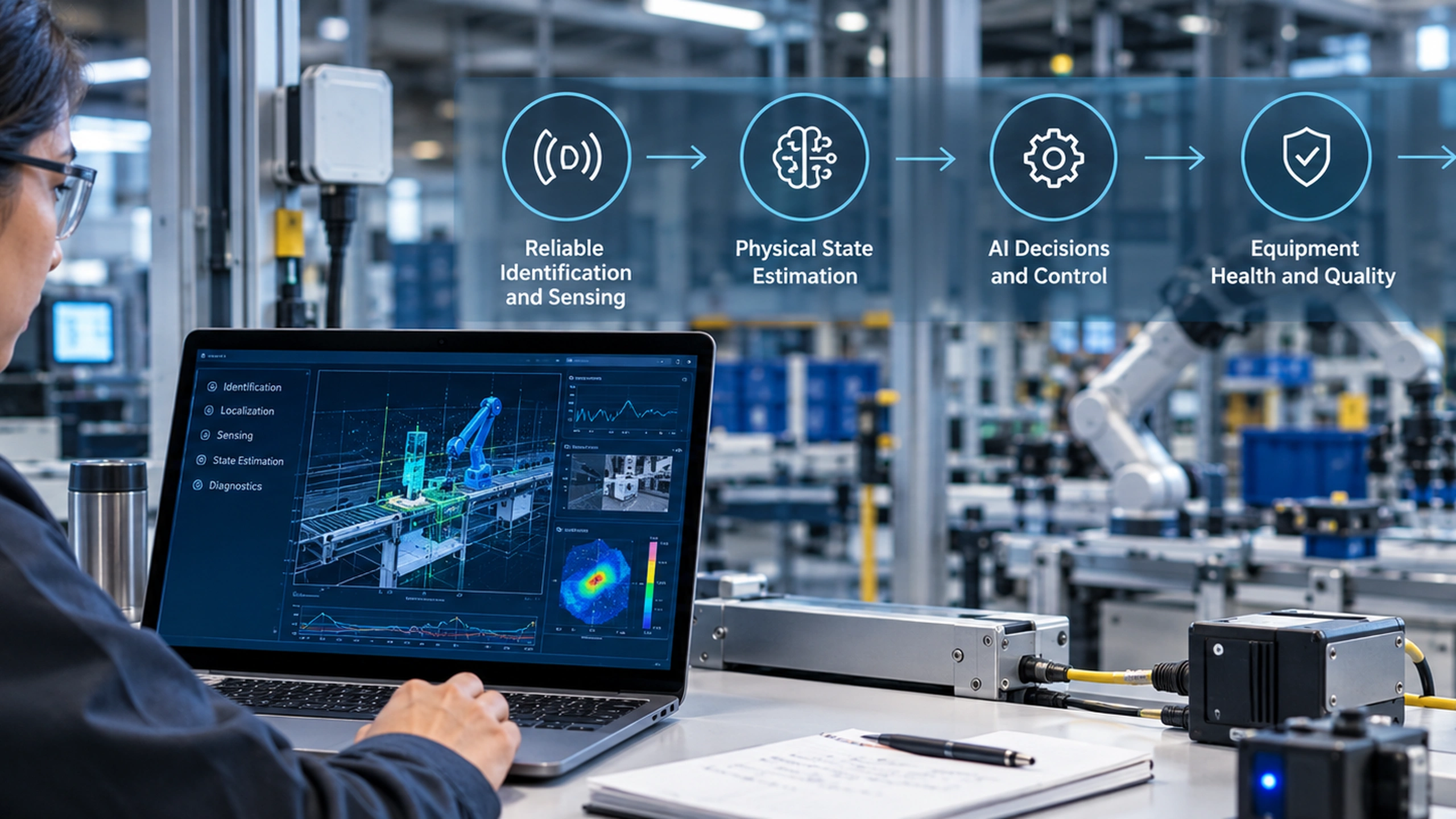
How This Program Supports the Aperture Engines | Aperture Identification and Sensing Labs
Aperture Identification and Sensing Labs focus on the evidence layer that helps physical AI systems understand what is present in an industrial environment, where it is, and how confidently its state can be estimated. The program studies identification, localization, multimodal sensing, sensor data quality, and traceability so downstream systems can work from a more dependable representation of the physical world.
Contact UsPhysical AI depends on more than a decision model. It also depends on observations that are correctly associated with objects, placed in context, aligned in time, and accompanied by an honest account of uncertainty. This program addresses those upstream challenges and connects its work to the broader research responsibilities of Aperture Physical AI Research Labs.
From sensor observations to usable physical state
Industrial observations are often incomplete or inconsistent. RFID reads may be missed, cameras may be occluded, location estimates may disagree, and records may arrive after the physical event. The program investigates how to associate observations with the right objects, estimate location and state, reconcile conflicting evidence, and identify when another measurement is needed.
The goal is not to claim certainty where the evidence is weak. The goal is to make physical state more useful by describing what is known, when it was observed, how reliable the evidence is, and what remains unresolved.
How the program connects to other research engines
Physical state estimation and world-state grounding
Identification and sensing provide observations that can contribute to a current representation of the physical environment. This includes object identity, location, event timing, movement, and uncertainty. World-state grounding can use this evidence to connect physical observations with the context required by other systems.
AI Decisions and Control
Decision and control systems need a sufficiently current and reliable estimate of the environment to choose and execute actions. Identification and Sensing contributes measurement and state-estimation evidence; the downstream decision engine remains responsible for interpreting that evidence in the context of objectives, constraints, and actions.
Equipment Health and Quality
Equipment and quality research may depend on trustworthy observations of assets, operating context, and events. This program can help establish whether an observation refers to the right asset and whether its timing and data quality are adequate. Equipment diagnosis and product-quality conclusions remain distinct research responsibilities.
Security and Trusted Industrial AI
Reliable sensing also supports trust assessment. Missing, delayed, inconsistent, or suspicious observations can affect the quality of a system’s understanding of the physical environment. Identification and Sensing focuses on measurement integrity and uncertainty, while security research addresses threats, attacks, and broader trust mechanisms.
A shared workflow across research areas
The relationship between the engines can be understood as a connected workflow: sensing produces observations; identification and state estimation associate those observations with physical entities and context; downstream systems use the resulting evidence for decisions, equipment analysis, quality assessment, or security evaluation. Feedback from testing and operations can reveal where sensing coverage, data quality, or uncertainty handling needs improvement.
This workflow is a conceptual description of research interfaces, not a claim that every component is currently integrated into a deployed system. Actual data interfaces, system boundaries, and integration status should be documented and verified before publication.
What the program contributes
The program’s intended contributions include methods for identification and localization, multimodal sensor fusion, inventory and movement understanding, sensor reliability and data quality, adaptive sensing, traceability, and world-state grounding. Contributions should be evaluated against explicit baselines and suitable ground truth, with attention to error distributions, false alarms, latency, uncertainty calibration, and performance when observations are missing or degraded.
Research status must be described accurately. Proposed methods, simulations, controlled testbed experiments, supervised pilots, and industrial deployments are different evidence stages. Performance figures, integration claims, facilities, and partnerships should be published only when supported by approved evidence.
Why the connection matters
Across manufacturing, warehousing, infrastructure monitoring, robotics, and product traceability, downstream reasoning is only as useful as the physical evidence available to it. By focusing on identity, location, timing, and sensor quality, Aperture Identification and Sensing Labs addresses foundational questions that can help other research programs reason about the physical world with greater clarity.