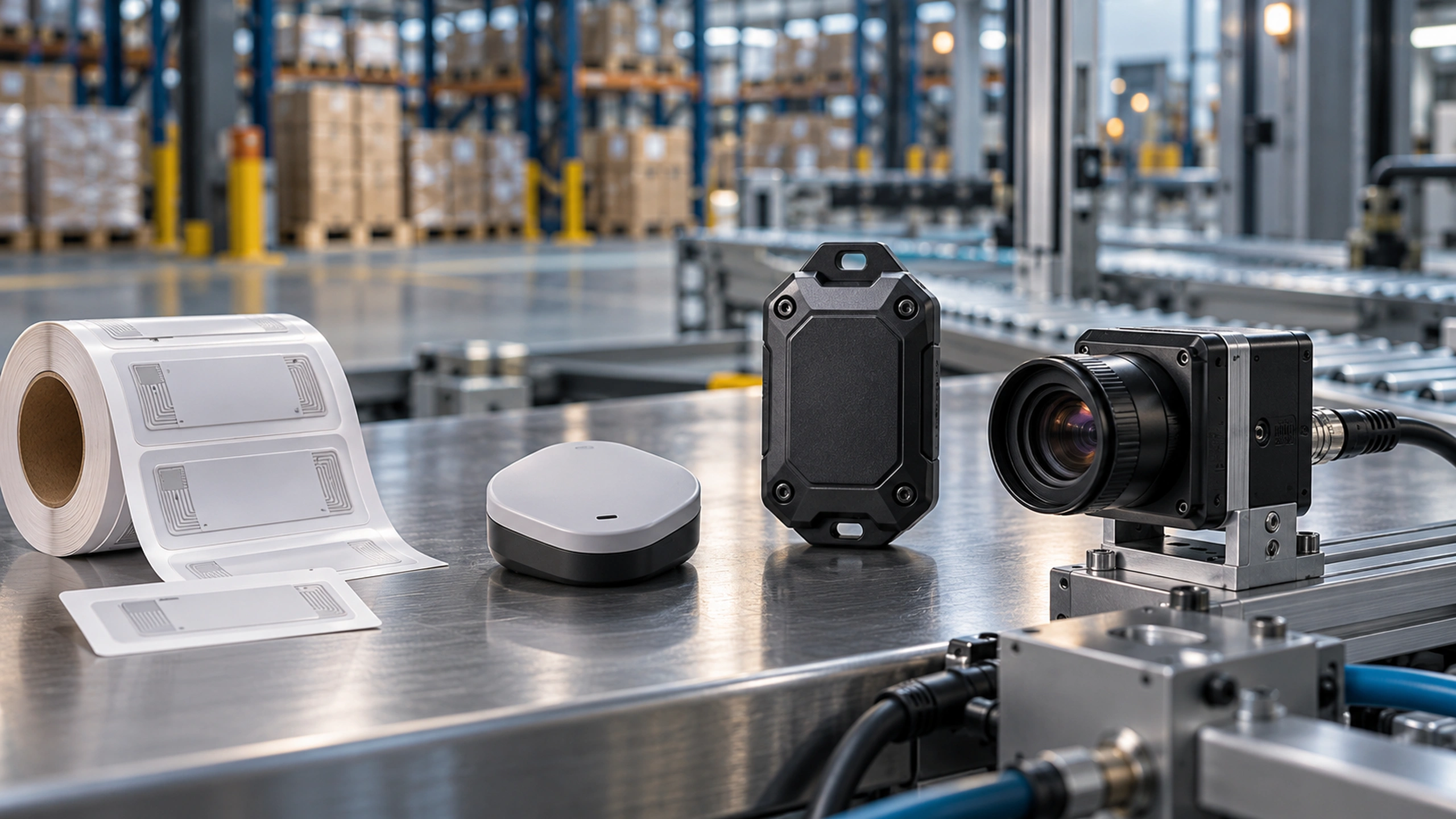
Industrial warehouse with shelving, cartons, gray asset bags on a pallet, and an overhead camera.

Knowledge Center

Industrial observations rarely provide a complete account of what is happening.
A reader can miss a tag, a camera can lose sight of a moving item, and a sensor
can deliver a plausible value with an incorrect timestamp.
The Knowledge Center explains how these limitations affect identity, location, condition, and operational context, and how research teams can evaluate them before relying on an estimated physical state.

Discuss a Research Project

These guides support the Industrial Identification Sensing and State Estimation program at Aperture Identification and Sensing Labs. They are written for industrial technical leaders, researchers, technology partners, and teams preparing a research challenge or supervised pilot. The focus is measurement quality and physical state estimation. Control decisions, equipment diagnostics, and sensor security connect to related research programs when the question extends beyond this scope.

Find the guide that matches your question

RFID vs BLE vs UWB for Industrial Research

Which observations does each technology provide, and which experiments make a comparison meaningful? This guide separates identification, proximity, ranging, and localization. It explains why a successful read does not necessarily establish a precise position and why a technology comparison should begin with the physical question rather than a headline accuracy claim.

Read the guide

How Sensor Fusion Handles Conflicting Observations

What should happen when a camera, radio reader, and location estimate disagree? Explore time alignment, identity association, uncertainty, and rules for accepting or rejecting evidence. The guide describes alternatives to fusion and explains how to compare a combined system with individual sensor baselines.

Read the guide

Calibration and Timestamp Alignment

Are two measurements comparable if their units, coordinate frames, or clocks differ? This guide explains the difference between calibration, synchronization, communication delay, and message matching. It offers a practical way to investigate timing and measurement errors before evaluating a combined state estimate.

Read the guide

Representing Uncertainty in Asset State

How can a system report what it knows without turning an incomplete observation into a certain conclusion? Learn how to represent ambiguous identity, uncertain location, stale measurements, and competing hypotheses. The guide connects state representation to evidence freshness and the need for an additional observation.

Read the guide

Read methods alongside evaluation

A method is useful only when its assumptions match the physical setting. Each guide explains the problem, available approaches, an illustrative industrial example, and limits that should remain visible during evaluation. Proposed examples describe research designs; they are not claims of completed Aperture experiments or deployed systems.

For example, a receiving trial might move tagged items into storage while deliberately introducing missed reads, camera occlusion, and delayed messages. An independently recorded account of identity and movement would help establish which observations were correct. Comparing the same trials across individual modalities and a combined approach would show where additional evidence helps and where it introduces new failure modes.

Evaluation should include difficult conditions, rejected observations, and recovery after a disruption. An average error alone can conceal occasional identity switches or a location estimate that remains stale after movement. Useful evidence connects each result to the apparatus, baseline, sample scope, ground truth, and conditions under which it was obtained.

Connect specialist concepts to industrial problems

For manufacturing, the practical question may be whether an item moved between stations or whether a read was missed. For warehouses, it may be whether a recorded transfer agrees with observed movement. For robots and vehicles, freshness can matter as much as position: a previously correct estimate may no longer support the next action.

Use the guides to define the observation required, the uncertainty that can be tolerated, and the independent reference needed for evaluation. Then connect that question to the appropriate research area and industrial application. Shared program resources remain on their authoritative central pages rather than being reproduced here.

Discuss a measurement or state estimation challenge

Describe the physical problem, relevant sensors, operating conditions, and desired outcome. A useful inquiry also explains the current baseline and the observation gaps that make the problem difficult. Avoid sending confidential files through the initial contact form.

Discuss a Research Project Part of Aperture Physical AI Research Labs
Scroll to Top