
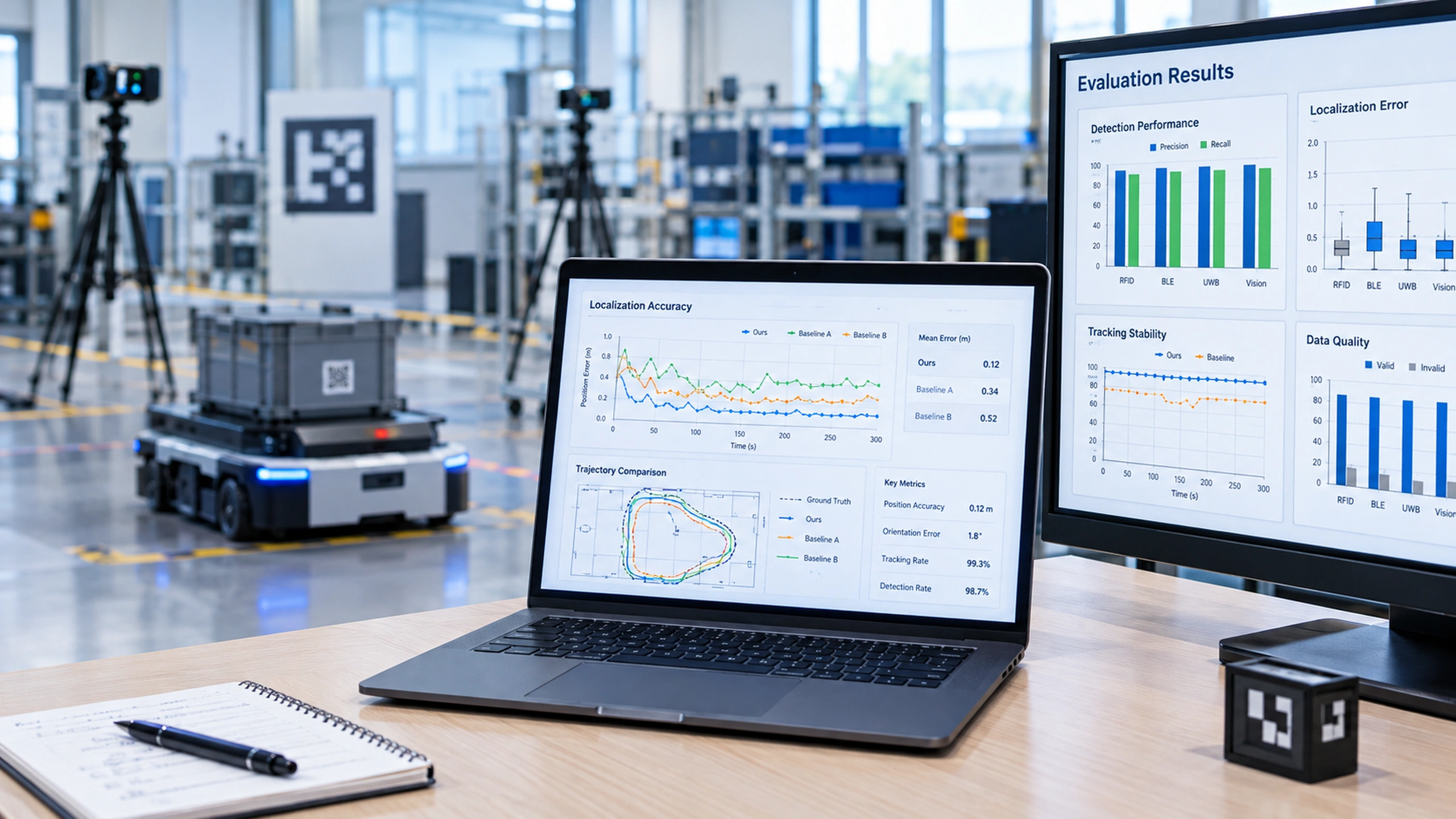
Evaluation Results for Industrial Identification and Sensing
Evaluation results are meaningful only when the measurement question, test conditions, reference data, and scoring rules are clear. For industrial identification and sensing, a result may describe whether an item was identified correctly, how accurately it was localized, whether its movement was tracked continuously, or how reliably events were reconstructed from multiple sensor streams.
Contact UsMeasure what a sensing system gets right—and where it remains uncertain
Aperture Identification and Sensing Labs uses this page to define how evaluation evidence should be presented and interpreted. This page does not report completed experiments or claim that any system has achieved a particular performance level. Numerical results should be added only after the underlying trials, datasets, baselines, and analysis have been reviewed.
What an evaluation should report
Each evaluation should state the question being tested, the system version, sensor configuration, environment, reference or ground-truth method, trial count, data exclusions, and evaluation metrics. Report the operating conditions that matter to the intended use, such as object density, movement speed, occlusion, radio interference, lighting, metal-rich surroundings, or sensor dropouts. A result obtained in a controlled testbed should not be presented as proof of performance in every facility.
Core evaluation dimensions
Identification quality
For identity assignment, report correct associations, missed detections, false associations, and unresolved or ambiguous cases. Precision and recall can be useful when the task and event definition are explicit. Include how duplicate identifiers, similar-looking objects, unreadable tags, and delayed observations are handled.
Localization accuracy
For position or orientation estimates, define the coordinate frame and compare estimates with an independent reference. Report an error distribution, such as median and selected percentiles, alongside sample scope and valid-observation coverage. State units and whether errors are two-dimensional, three-dimensional, or orientation-based. A single average can conceal large errors or periods with no usable estimate.
Tracking continuity
Tracking evaluation should consider continuity over time, identity switches, track fragmentation, missed intervals, recovery after loss, and false tracks where relevant. A system that is accurate when a track is available may still be unsuitable if it frequently loses the object. Explain how track starts, ends, and temporary occlusions are scored.
Sensor fusion and conflict handling
When combining RFID, BLE, UWB, vision, or other inputs, compare the fused estimate with suitable individual-sensor baselines. Describe how disagreement, stale readings, missing data, and confidence values are handled. Report whether the fused method improves the target metric under the tested conditions, and also document cases where fusion offers no benefit or degrades performance.
Data quality and event reconstruction
For event and state reconstruction, evaluate timestamp consistency, missing or duplicated records, event precision and recall, timing error, and the amount of manual reconciliation where appropriate. State how clock offsets and out-of-order observations are treated. Do not assume that a complete event log necessarily reflects the physical process accurately.
Latency and operational behavior
Where relevant, report end-to-end latency, update rate, availability, resource use, and recovery behavior. Explain whether timing was measured from sensor acquisition, message receipt, inference completion, or publication of the final state. A latency figure without a defined start and end point is difficult to compare.
Recommended evaluation workflow
Define the target claim and metric before examining results.
Document the test environment, sensor placement, software and configuration versions, and operating conditions.
Establish a reference method whose uncertainty is suitable for the question being tested.
Synchronize clocks and record missing data, sensor health, and any changes made during a trial.
Compare with relevant baselines using the same test cases and scoring rules.
Repeat trials and report variation; use held-out conditions where model tuning could otherwise bias the evaluation.
Preserve failed trials and document exclusions, corrections, and limitations.
Have a technical reviewer check calculations, plots, and wording before public release.
How to present results transparently
A public result card or report should include the research question, test conditions, method, baseline, metric definition, sample scope, result, uncertainty or variation, date, and review status. Graphs should label axes and units and identify the dataset or trial conditions. If the result is preliminary, say so clearly. If a result is simulated, label it as simulated and keep it separate from physical testbed evidence.
Do not publish unsupported headline percentages, best-case examples without context, or comparisons based on different conditions. Where evidence is not yet available, publish the evaluation protocol and identify the measurements planned for collection instead of filling the gap with invented values.
Current evidence status
No Aperture-specific evaluation datasets, trial records, baselines, measurements, or reviewed result tables were provided for this draft. Accordingly, this page defines a reporting framework rather than claiming completed performance outcomes. Add a result only when the supporting evidence and reviewer approval are available.
Call to action
Planning an evaluation or comparing sensing approaches? Discuss a Research Project with Aperture Identification and Sensing Labs to define the test conditions, reference measurements, baselines, and reporting criteria for your challenge.