
About Aperture Identification and Sensing Labs | Industrial Research
Aperture Identification and Sensing Labs studies how industrial systems can establish dependable identity, location, condition, and operational context when observations are incomplete, delayed, noisy, or in conflict. The program focuses on the measurement and state-estimation layer that helps people and physical AI systems understand what is present, where it is, and what can reasonably be inferred from available evidence.
Contact UsIndustrial environments rarely provide a perfect view of the physical world. Radio-frequency identification (RFID) reads can be missed, cameras can be occluded, timestamps can drift, location estimates can disagree, and records can lag behind physical movement. A useful system must do more than collect sensor readings. It must associate observations with the right objects, represent uncertainty, detect unreliable data, and update its view as new evidence arrives.
Our mission
Our mission is to develop and evaluate methods for turning imperfect sensor observations into a more dependable representation of physical state. This includes determining which item or asset an observation refers to, estimating its location, tracking changes over time, and making uncertainty visible rather than hiding it behind a single confident answer.
The intended outcome is a stronger evidence base for industrial monitoring, traceability, inventory understanding, robotics, and other applications that depend on accurate physical context. The program treats measurement quality and state estimation as core research problems, not as assumptions that can be taken for granted.
Research scope
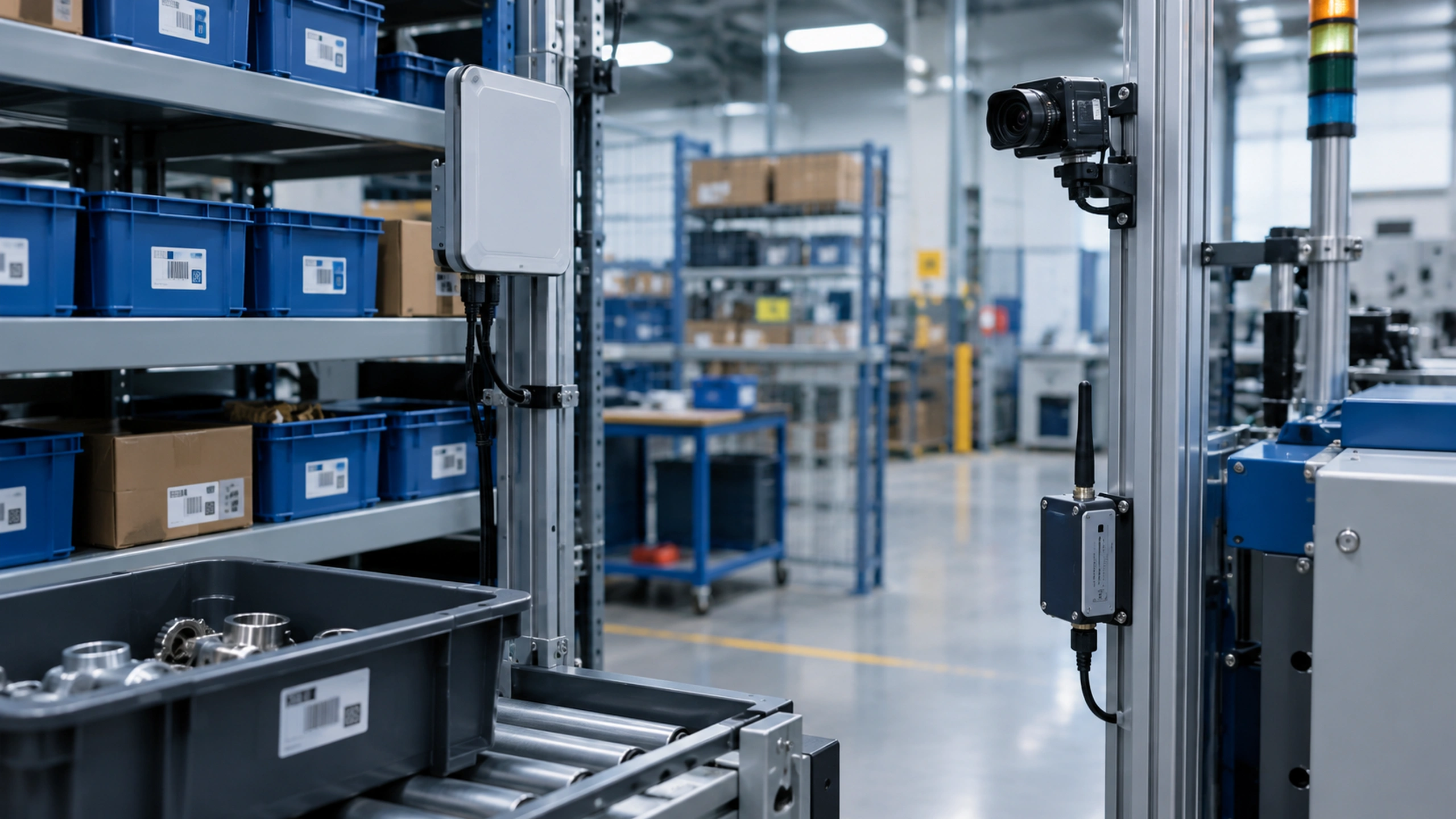
The program brings together identification, localization, multimodal sensing, data quality, and world-state grounding. Research topics include combining RFID, Bluetooth Low Energy (BLE), ultra-wideband (UWB), and vision; aligning observations in time; reasoning about missing or contradictory measurements; detecting sensor drift and stale values; understanding inventory movement; and representing traceability when an item’s history contains gaps or transformations.
A central question across these topics is when the available evidence is sufficient and when a system should reject an observation, lower its confidence, reconcile records, or request another measurement. Evaluation should consider not only average accuracy but also error distributions, identity switches, false alarms, latency, recovery behavior, and performance under held-out or degraded conditions. Numerical targets and claims of improvement require technical review and supporting evidence.
How the program fits within Aperture Physical AI Research Labs
Aperture Identification and Sensing Labs is part of Aperture Physical AI Research Labs. Its role is to establish the quality of measurements and estimates of physical state that other components can use. Research on control decisions belongs with AI Decisions and Control; equipment diagnostics and quality belong with Equipment Health and Quality; and sensor attacks and related trust questions belong with Security and Trusted Industrial AI. These boundaries support collaboration while keeping the research responsibilities clear.
Learn more about the wider organization at https://aperturephysicalailabs.com/ and see the central program overview at https://aperturephysicalailabs.com/research-programs/identification-sensing/.
Research approach and evidence
The program’s work should connect a defined physical problem to a testable research question, a documented method, an appropriate baseline, independent ground truth, and metrics that reflect the intended use. Tests may examine missed reads, occlusion, similar-looking items, delayed events, interference, or sensor loss. Reports should describe the test conditions and limitations, including failures and cases where the method does not support a reliable conclusion.
Research status will be stated explicitly. Proposed experiments are not completed studies, simulations are not physical trials, and results from a controlled testbed do not by themselves establish performance in a live industrial deployment. Facilities, equipment, collaborators, publications, and performance figures will be described only when verified and approved for publication.
Industrial relevance
The research is relevant to manufacturing and work-in-progress tracking, warehouse and asset management, infrastructure monitoring, robot and vehicle localization, and material or product traceability. Across these settings, the practical challenge is similar: operational decisions depend on a current and defensible account of physical state, even when the available observations are partial or inconsistent.
Applications are evaluated in context. A method that works under clear line of sight may behave differently around metal structures, in dense storage areas, or during handoffs between sensing systems. Pilot questions should therefore identify the operating environment, available data, baseline process, access requirements, evaluation criteria, and responsibilities before outcomes are claimed.
Work with us
We welcome inquiries from industrial technical teams, researchers, and technology partners with concrete identification, sensing, or state-estimation challenges. A useful initial discussion describes the physical process, the observations currently available, the uncertainty or failure that matters, and the outcome that would make an evaluation valuable. Please do not submit confidential files through an initial inquiry.