
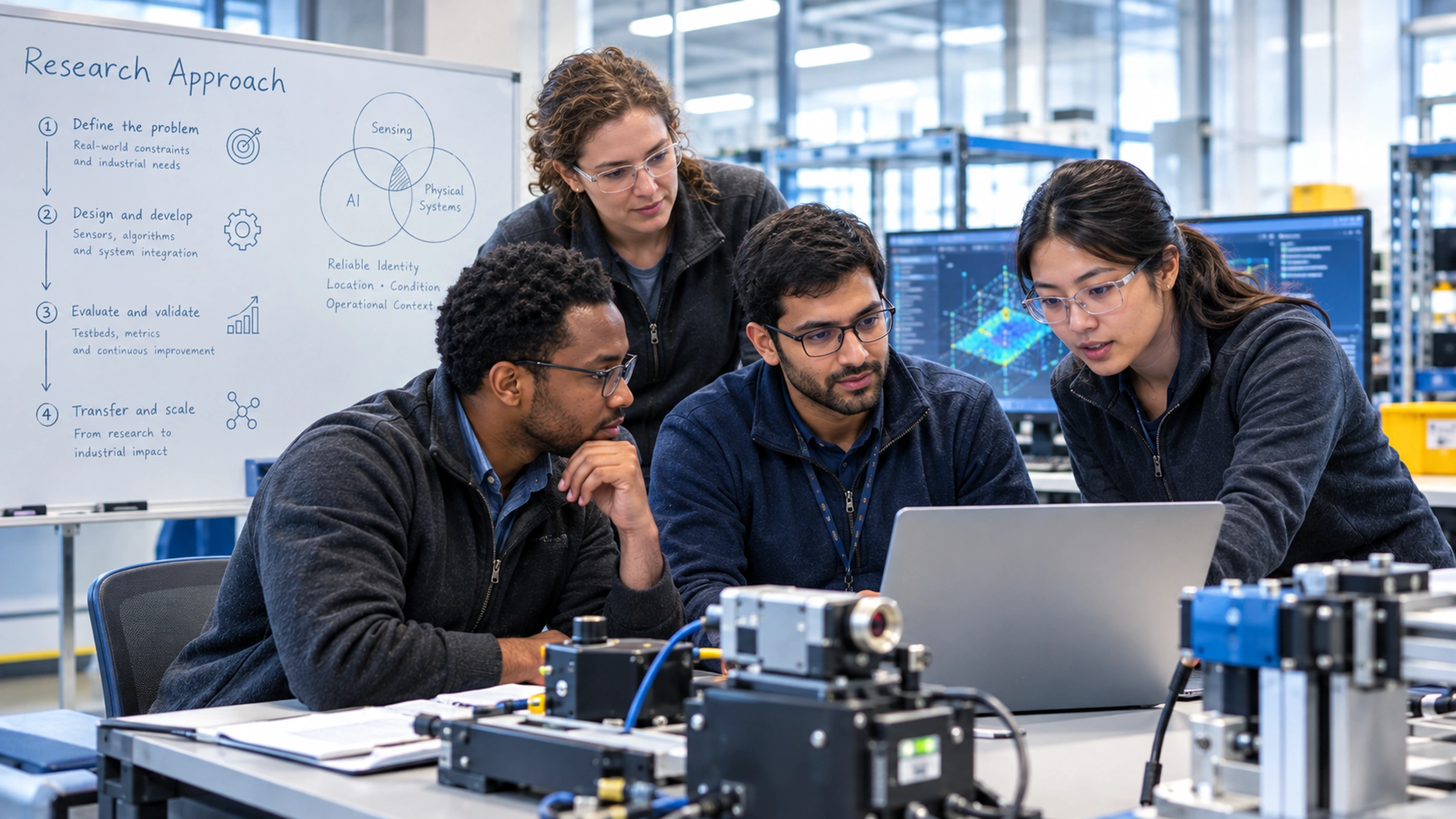
Research Approach | Aperture Identification and Sensing Labs
Aperture Identification and Sensing Labs studies how industrial systems can establish dependable identity, location, condition, and operational context from imperfect observations. Our research approach starts with a physical problem and works toward methods that can be evaluated against evidence, with uncertainty and limitations made explicit.
Contact UsIn industrial environments, sensor readings may be missing, delayed, noisy, or inconsistent. A tag may not be detected, a camera view may be blocked, clocks may disagree, or a recorded movement may arrive after the physical event. Research must account for these conditions rather than assume that every observation is complete and correct.
Start with the physical problem
Each research effort should begin by describing the physical process, the people or systems that rely on its information, and the consequences of an incorrect or outdated estimate. This definition guides the research question, the observations required, and the conditions under which a result would be useful.
The problem statement should identify the objects or assets of interest, the relevant location and time context, the expected changes in state, and the failure modes that matter. Where uncertainty is material, the question should include when an observation should be rejected, qualified, reconciled, or followed by another measurement.
Select methods to match the question
The program’s research scope includes RFID, Bluetooth Low Energy (BLE), ultra-wideband (UWB), vision, and other sensing approaches where relevant to the physical problem. Method selection should account for the environment, expected range and precision, occlusion, interference, power constraints, data availability, and the cost of collecting additional observations.
When multiple sources are available, research may examine time alignment, data association, coordinate frames, uncertainty representation, and multimodal fusion. Combining sensors is not automatically better: fusion must be compared with individual modalities and evaluated for error, confidence calibration, processing latency, and performance when observations are missing.
Define baselines and ground truth
An evaluation needs a documented baseline and an independent reference for the property being measured. Depending on the question, ground truth may require separately recorded identity, position, event timing, or asset-state records. The method used to establish ground truth should be described so readers can understand its precision, coverage, and possible sources of error.
Comparisons should use consistent scenarios and clearly state the sample scope, units, measurement procedure, and any exclusions. Where feasible, evaluation should include held-out conditions rather than only the conditions used to develop or tune a method.
Measure performance and uncertainty
Metrics should follow from the research question. Relevant measures may include identity switches, localization-error distributions, event precision and recall, inventory accuracy, fault-detection delay, false-alarm rate, fusion error, confidence calibration, latency, recovery time, or reconciliation effort.
A single average can hide important failure cases. Reports should describe distributions, relevant edge cases, missing data, and the conditions under which the method becomes unreliable. Numerical targets should be set only after technical review and should be reported only when supported by actual measurements.
Test under realistic and degraded conditions
A research plan should state which conditions will be tested, which will be held out, and how the setup represents the intended environment. Scenarios may include missed reads, camera occlusion, similar objects, delayed events, interference, sensor loss, clock faults, and transitions between indoor and outdoor spaces, where these are relevant to the question.
The evidence stage must be explicit. A proposed experiment is a plan, a simulation is not a physical trial, a controlled testbed does not establish industrial deployment performance, and a supervised pilot should not be described as a deployment without verification. Reports should include unsuccessful runs and limitations as well as positive findings.
Document decisions, limits, and reproducibility
Technical handoffs should record the question, assumptions, data sources, method version, baseline, ground-truth procedure, metrics, test conditions, results, limitations, and unresolved questions. Where access and permissions allow, supporting materials should make it possible for qualified reviewers to understand how conclusions were reached.
The aim is not to claim certainty where evidence is incomplete. A dependable state estimate should communicate what is known, when it was observed, how strong the supporting evidence is, and when the system should seek new observations or defer a conclusion.
Connect research to industrial needs
The approach is relevant to manufacturing and work-in-progress tracking, warehouses and asset tracking, infrastructure monitoring, robot and vehicle localization, and material and product traceability. Each application has different operating constraints, so evaluation criteria should be agreed in the context of the process, baseline workflow, available observations, and intended use.
The program’s scope centers on measurement quality and physical state estimation. Control decisions connect to AI Decisions and Control; equipment diagnostics connect to Equipment Health and Quality; and sensor attacks connect to Security and Trusted Industrial AI. These boundaries help research efforts use the appropriate expertise without confusing measurement evidence with downstream decisions.
Discuss a research question
Researchers, industrial technical teams, and technology partners can propose a specific sensing or state-estimation challenge. An initial discussion is most useful when it identifies the physical process, the failure or uncertainty to investigate, the available types of observations, and the outcome that would make an evaluation meaningful. Do not send confidential files through an initial inquiry.