
Ground Truth Methods for Industrial Identification and Sensing
Contact UsIndependent reference measurements for reliable evaluation
A sensing system can report an object’s identity, position, orientation, or movement, but its output alone cannot establish whether that estimate is correct. Ground truth is an independently obtained reference used to evaluate a system under test. For industrial identification and sensing, a useful reference must describe what happened, where and when it happened, and how confidently those facts are known.
Aperture Identification and Sensing Labs focuses on measurement quality and physical state estimation. Ground truth methods support that work by making it possible to compare observations from RFID, Bluetooth Low Energy (BLE), ultra-wideband (UWB), cameras, and other sensors against a separately recorded reference. The appropriate method depends on the physical quantity being evaluated, the environment, the required uncertainty, and the practical constraints of the test.
What ground truth needs to establish
Ground truth is not a universal label that makes a dataset correct in every respect. It is a reference defined for a specific question and operating range. An experiment should state whether the reference describes object identity, a two-dimensional or three-dimensional position, orientation, a passage through a boundary, a process event, or a sequence of custody changes. It should also define the coordinate frame, timestamp convention, units, and rules for ambiguous or unobservable cases.
The reference method should be independent of the system being evaluated wherever practical. Reusing the same sensor stream or algorithm to generate both the estimate and its supposed ground truth can conceal shared errors. Reference uncertainty must also be considered: a measurement system with insufficient accuracy may not be able to distinguish the system under test’s error from its own.
Methods and their appropriate uses
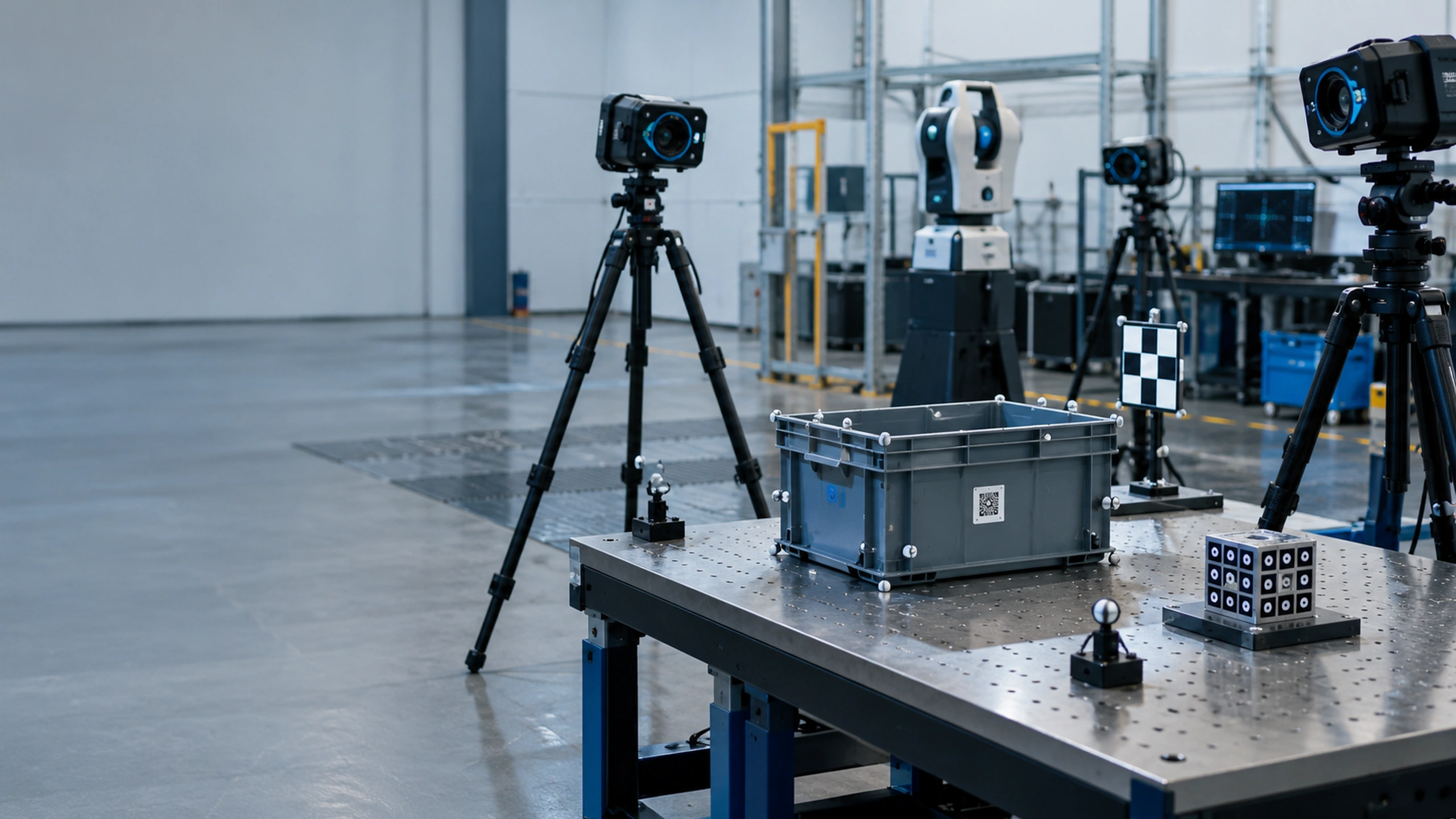
Optical motion capture or multi-camera tracking can provide time-aligned position and orientation estimates for objects fitted with visible markers. It can be useful for controlled indoor experiments and robot or object tracking. Occlusion, calibration, reflective surfaces, marker placement, field of view, and the relationship between marker coordinates and the object’s reference frame can limit its use.
Surveyed fixtures, calibration artifacts, and mechanical constraints can establish known positions or orientations at selected points. These methods are often useful for repeatable static checks and controlled poses. They may not represent the full range of motion, vibration, slippage, or interactions found in a moving industrial process.
Independent physical sensors, such as a separately configured tracking instrument or a measurement system with a documented reference, can record dynamic events and states. Their suitability depends on calibration, traceability, sampling rate, synchronization, coverage, and measurement uncertainty. A sensor is not ground truth simply because it is separate; its performance must be characterized for the intended use.
Human annotation can label visible objects, events, or states when automated measurement is impractical. Annotation guidance should define the label set, boundary cases, review process, and how disagreements are handled. Annotation is valuable for semantic questions, but it should not be presented as precision position measurement unless the method supports that claim.
Physics-based simulation can provide exact internal state for simulated scenes, including object poses and event timing. Simulation ground truth is useful for controlled coverage of rare or difficult conditions, but it describes the simulated world rather than proving performance in a physical facility. Results from simulated trials must be reported separately from physical measurements.
Proposed experimental workflow
A proposed starting experiment for this program would move tagged items through receiving, storage, and a simulated workstation. The test would introduce missed reads, camera occlusion, visually similar objects, and delayed events. Each sensing modality and a combined approach would be compared with independently recorded identity and location. This experiment is proposed, not completed, and should be adapted after the available equipment, data permissions, and reference-measurement capability are confirmed.
Define the physical question, target quantities, coordinate frames, units, timing requirements, and intended operating conditions.
Select a reference method and document its calibration, coverage, expected uncertainty, sampling rate, and known failure modes.
Synchronize reference and test-system clocks, record clock offsets and missing data, and define how measurements are associated across time.
Create a repeatable scenario plan covering normal operation, sensor loss, interference, occlusion, delays, similar objects, and recovery.
Keep reference data separate from the input available to the system under test. Record provenance, transformations, manual corrections, and exclusions.
Predefine evaluation metrics and acceptance rules before inspecting results. Preserve unsuccessful trials and report exclusions with reasons.
Repeat trials and reserve held-out conditions where appropriate, so tuning on the same observations does not become the only evidence of performance.
Baselines, metrics, and reporting
A baseline makes results interpretable. Depending on the question, compare each sensor independently with a fused estimate, or compare an evaluated system with a simple reference method. State the dataset or trial scope, number and type of observations, environmental conditions, and any missing or excluded intervals. Numerical targets should be approved by the technical lead rather than introduced as unsupported claims.
For localization, report the error distribution rather than only a single average. Suitable summaries may include median and percentile errors, the coordinate frame, and the proportion of valid observations. For tracking, report identity switches, missed and false associations, and recovery time after a loss. For event reconstruction, report event precision and recall, timing error, and reconciliation effort where those measures fit the research question. Include latency and confidence calibration when the system exposes confidence estimates.
The report should describe the reference system’s own uncertainty and limitations alongside the evaluated system’s performance. If the reference is unavailable during occlusion or loses synchronization, mark those intervals explicitly rather than silently treating estimates as correct. Graphs should only be published when supported by actual measurements and should identify units, baselines, sample scope, and uncertainty.
Limitations and interpretation
No single ground truth technique is appropriate for every industrial setting. Optical tracking may struggle with occlusion or line-of-sight restrictions; fixtures may not capture dynamic behavior; annotations can vary between reviewers; independent sensors can have their own biases; and simulation may omit important physical effects. Combining methods can improve coverage, but it also introduces alignment and data-association questions that need to be documented.
Ground truth supports verification of a defined property under stated conditions. It does not by itself establish broad deployment readiness, safety, certification, or performance outside the tested scope. Claims should distinguish proposed work, simulated trials, physical testbed measurements, supervised pilots, and deployments for a defined use.
Related research and resources
Contact us
Have a measurement challenge involving object identity, location, tracking, or process events? Discuss a Research Project with Aperture Identification and Sensing Labs to define the physical question, reference requirements, test conditions, and an appropriate evaluation plan.
Discuss a Research Project