
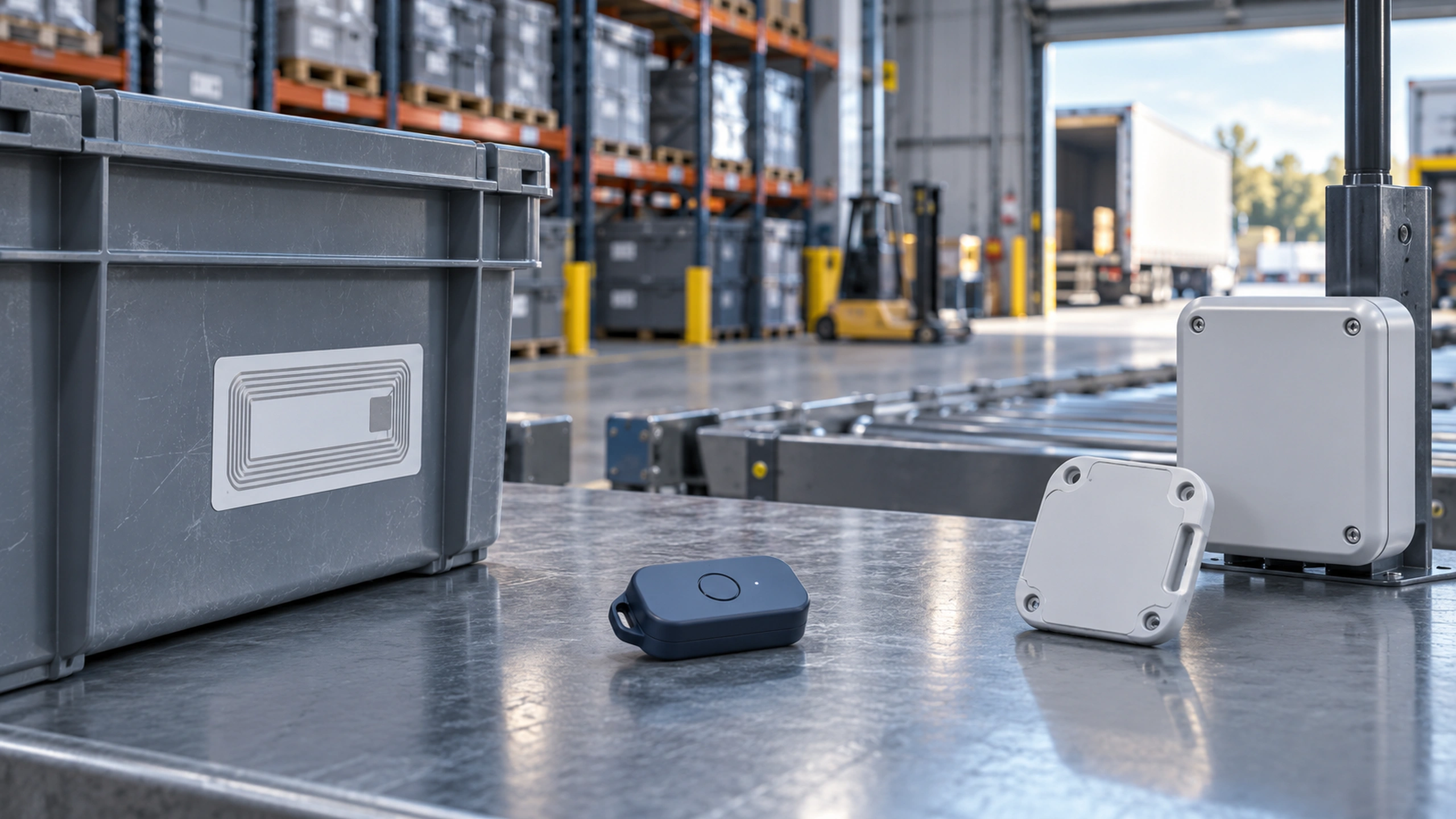
A tagged industrial tote beside compact wireless beacons and a positioning anchor in a warehouse.

RFID vs BLE vs UWB for Industrial Research

A technology comparison begins with the observation an industrial process needs. Detecting a tagged item at a doorway, estimating which zone contains it, and measuring its position during movement are different tasks. RFID, Bluetooth Low Energy, and ultra-wideband can support overlapping applications, but they do not automatically produce equivalent evidence.

Discuss a Research Project

This guide explains how to compare these technologies for identification and localization research. The practical conclusion is to define the physical question, establish an independent reference, and evaluate each candidate under the same relevant conditions. No universal accuracy, read range, or deployment outcome is assumed.

Separate identity from location

Identification associates an observation with an item or device. Localization estimates position in a defined coordinate frame. A reader may recover a tag identifier without establishing the exact position of the object carrying it. A radio location estimate may refer to a device whose attachment to a physical item has not been checked.

The association between tag and object therefore needs its own evidence. Record how identifiers are assigned, whether tags can be moved, and how duplicate or replacement identifiers are handled. A technically correct radio measurement can still produce a wrong item record when this association fails.

For an industrial trial, specify whether success means detecting passage, assigning a storage zone, estimating coordinates, or recovering identity after an observation gap. These definitions determine the apparatus and metrics required.

What each technology contributes

RFID

Radio-frequency identification covers several technology families. This comparison focuses on passive UHF RFID, commonly used for tagged-item identification. GS1's EPC Gen2 protocol defines communication between interrogators and passive tags. A passive tag obtains operating energy from the reader field rather than requiring an onboard battery for ordinary identification.

Reader and antenna placement help define the observation region, but a read should not be treated as an exact coordinate. The research question is often whether the correct identity can be associated with a particular event or zone. Item orientation, packaging, mounting, and neighboring materials should be included in the test plan. Other RFID families and specialized positioning methods need separate evaluation.

Bluetooth Low Energy

BLE devices can transmit identifiers that nearby receivers observe. Received signal strength can support proximity or zone inference, but it is an indirect observation affected by the radio environment. A change in signal strength should not automatically be interpreted as a corresponding change in distance.

Bluetooth Direction Finding adds angle-of-arrival and angle-of-departure methods. These require compatible hardware and antenna arrangements; an ordinary beacon installation does not acquire direction-finding capability simply because it uses BLE [2]. Bluetooth Channel Sounding provides another ranging approach on supported devices. These BLE methods should be treated as distinct configurations in a comparison rather than grouped under one claimed accuracy.

Ultra-wideband

UWB systems can use signal timing to estimate distance, and appropriate anchor arrangements can support localization. Time-of-flight ranging measures propagation time between devices [3]. The resulting position still depends on installation geometry, calibration, available observations, and the estimator used.

A ranging system needs tests under obstruction and changing layouts, not only favorable line-of-sight conditions. Record which measurements were accepted, which were rejected, and whether the system recovered after loss of coverage. A location estimate does not by itself prove the object's identity or operational status.

Compare the observation rather than the label

Technology configuration Typical observation Evaluation question
Passive UHF RFID Tag identifier observed by a reader Was the correct item associated with the correct passage or zone?
BLE received signal strength Identifier and signal strength at receivers Does zone inference remain useful as layout and obstruction change?
BLE Direction Finding Signal direction from compatible hardware Does surveyed locator geometry support the required position estimate?
UWB ranging or localization Range observations or estimated coordinates How do geometry and blocked paths affect error and availability?

This comparison describes research functions, not a ranking of products. Device specifications, installation effort, maintenance, update rate, and integration requirements should be recorded separately. A system that answers the required question with less complexity can be a stronger baseline than a more elaborate installation.

Design a fair industrial experiment

Consider a proposed receiving-to-storage trial using tagged totes. Move each tote through a receiving region, along a storage aisle, and to a simulated workstation. Independently record object identity and movement using a reference method whose limitations are documented. Do not use the candidate tracking system as its own ground truth.

Run each candidate over a matched set of routes and operating conditions. Include item crowding, different tag orientations, obstruction, delayed messages, and temporary coverage loss. Reserve conditions or routes that were not used to tune the system. Document the number of trials and failures, rather than reporting only successful demonstrations.

Compare item-level detection and association separately from coordinate accuracy. For localization, report the error distribution and availability. For event detection, report precision and recall with an explicit event definition. Include identity switches, time to recover after disruption, and the age of the state estimate at the point where it would be used.

Know when a combination is justified

A combination may be useful when one modality supplies identity and another supplies motion or location evidence. The benefit must be demonstrated against individual modalities on the same task. Additional sensors introduce time alignment, coordinate transformation, and identity association requirements that can create errors of their own.

Alternatives include a deliberately constrained read zone, a manual confirmation step, or a simpler zone-level estimate. The appropriate comparison depends on the consequence of an incorrect event or stale position. Define that consequence before deciding how much sensing infrastructure is justified.

Discuss your identification or localization question

Describe the item association problem, required observation, operating environment, and existing baseline. Include whether the desired outcome is passage detection, zone assignment, or a position estimate.

Discuss a Research Project
Scroll to Top